Why Consistent Routines Matter More Than Perfect Ones
In our collective pursuit of excellence, we often fall into the seductive trap of perfectionism. We envision the ideal morning, the flawless workout, and the perfectly balanced diet, believing that unless we execute these plans with absolute precision, we have failed. However, experience and behavioral science suggest a different reality. We have observed that the most successful individuals are not those who perform perfectly on their best days, but those who show up consistently on their most difficult ones. This article explores why the longevity of a habit is far more valuable than the intensity of a single performance, and how shifting our focus from perfection to consistency can transform our long-term trajectory.
The Psychological Trap of Seeking Perfection in Habits
Conceptual image of the fragility of perfectionism in habits.
We must recognize that the desire for a "perfect" routine is often a masked form of procrastination. When we demand perfection from ourselves, we create an impossibly high barrier to entry. This phenomenon, often referred to as "all-or-nothing thinking," dictates that if we cannot complete our full sixty-minute gym session, there is no point in going for fifteen minutes. This mindset is fundamentally flawed because it ignores the neurological benefits of the act of showing up.
Perfectionism creates a fragile system. When life inevitably interferes—be it through illness, professional emergencies, or personal obligations—a perfection-based routine shatters. Because the individual has tied their success to a specific, rigid standard, any deviation feels like a total collapse of the habit. This leads to the "what the hell" effect, a well-documented psychological occurrence where a small slip-up leads to a complete abandonment of the goal. We argue that by lowering the threshold for success, we can bypass this fragility and build a resilient psychological framework that withstands the chaos of daily life.
Furthermore, the stress of maintaining a perfect routine increases cortisol levels, which can actually impair our ability to form new habits. The brain’s prefrontal cortex, responsible for executive function and decision-making, becomes taxed when we constantly obsess over minute details. By shifting our focus to simply "doing the thing," regardless of how well it is done, we reduce this cognitive load, making the routine easier to sustain over months and years.
Why Consistency Outperforms Perfection Every Time
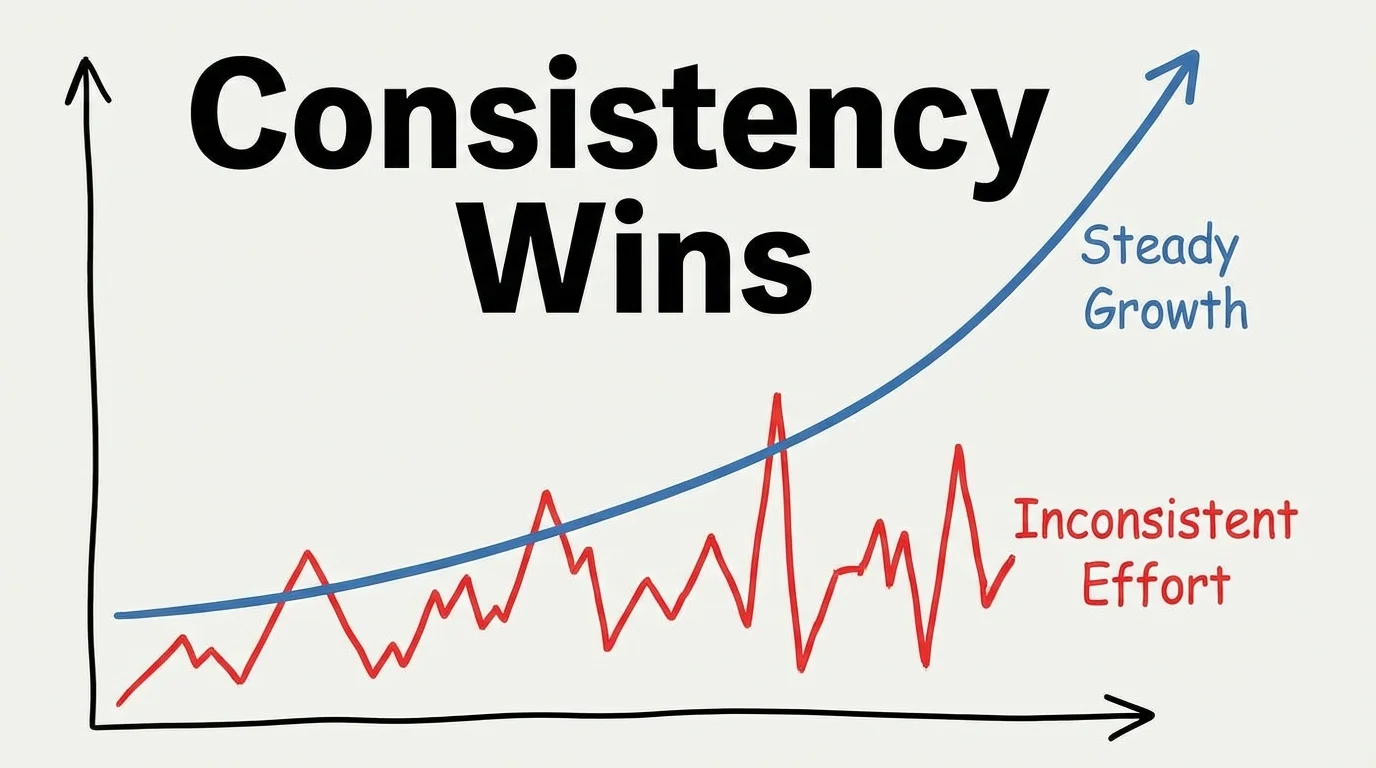
Graph comparing consistent progress versus intermittent perfection.
The primary reason consistency triumphs over perfection lies in the compound effect. Much like financial interest, the benefits of our habits compound over time. A person who walks for twenty minutes every single day will, at the end of a year, be in significantly better health than someone who runs a marathon once and then remains sedentary for the next three months. We must understand that repetition is the primary driver of skill acquisition and physiological adaptation.
When we prioritize consistency, we are prioritizing the frequency of the stimulus. Whether we are learning a new language, building a business, or improving our fitness, the brain requires frequent reminders to strengthen the neural pathways associated with those activities. A "perfect" session once a week provides far less stimulus than a "good enough" session five times a week. The sheer volume of engagement allowed by a consistent approach leads to a higher total output and more profound long-term mastery.
Moreover, consistency builds identity. Every time we perform a habit, we are casting a vote for the type of person we wish to become. If we show up to write, even if the prose is lackluster, we are reinforcing the identity of a "writer." If we go to the gym for ten minutes on a day we feel exhausted, we are reinforcing the identity of an "athlete." Perfectionism focuses on the outcome, but consistency focuses on the process and identity
, which are the true foundations of permanent lifestyle change.
The Science of Habit Formation and Neural Plasticity
Digital representation of brain pathways and habit formation.
To understand why consistency is paramount, we must look at the mechanics of the human brain. Habit formation is governed by the basal ganglia, a region of the brain involved in emotion, pattern recognition, and memories. For a behavior to become automatic—a process known as automaticity—it must be repeated enough times that the brain can delegate the task to the basal ganglia, freeing up the prefrontal cortex for other tasks.
This transition from conscious effort to subconscious habit is driven by long-term potentiation (LTP). LTP is the process by which synaptic connections between neurons become stronger with frequent activation. Every time we repeat a routine, we are physically reshaping our brain. Perfection is irrelevant to this biological process; only repetition and frequency matter. The brain does not distinguish between a "perfect" 10-kilometer run and a "struggling" 2-kilometer run in terms of the habit loop—it simply registers that the activity took place.
By focusing on consistency, we take advantage of synaptic pruning. The brain is an efficiency-seeking organ; it prunes away connections that are rarely used and reinforces those that are used daily. If we wait for the "perfect" conditions to act, we are not providing enough consistent data for the brain to prioritize those pathways. Therefore, we advocate for a "never miss twice" rule. While missing one day is a biological blip, missing two days begins to establish a new, competing pattern of inactivity.
Building a Sustainable Framework for Long-Term Routine
Conceptual image of building a sustainable habit framework.
To move away from perfectionism, we must design routines that have a low floor and a high ceiling. A "low floor" means that the minimum requirement to maintain the habit is incredibly easy to achieve. For instance, if the goal is daily meditation, the low floor might be just sixty seconds of mindful breathing. On days when we have more time and energy, we can aim for the "high ceiling" of thirty minutes. This structure ensures that the habit chain remains unbroken, regardless of external circumstances.
We also recommend the implementation of implementation intentions, more commonly known as "if-then" planning. This involves pre-deciding how we will maintain our routine when obstacles arise. For example: "If I have to stay late at the office, then I will do a ten-minute bodyweight circuit at home instead of going to the gym." This strategy removes the need for willpower in the moment of stress, allowing us to maintain consistency through pre-planned flexibility.
Furthermore, we must embrace the concept of "reducibility." If a routine feels overwhelming, it is too complex. We should strip the habit down to its most basic component and master the art of showing up before we worry about the intensity or duration. A sustainable framework is one that feels almost "too easy" at the start. This allows us to build the momentum necessary to carry us through the inevitable periods of low motivation.
Overcoming the "Missed Day" Syndrome and Building Resilience
A person recovering from a setback to continue their routine.
One of the greatest enemies of consistency is the shame associated with a missed day. We often observe that individuals allow one mistake to spiral into weeks of inactivity. To combat this, we must develop psychological resilience. We need to view our routines not as a fragile glass ornament, but as a resilient muscle. Muscles grow through tension and recovery; similarly, our habits are strengthened by our ability to return to them after a disruption.
We should treat a missed day as a data point rather than a moral failure. We ask ourselves: "What caused the disruption, and how can we adjust the system to prevent it next time?" This analytical approach replaces guilt with curiosity. When we remove the emotional weight of perfection, we find it much easier to simply restart the following day. Resilience is the ability to maintain the long-term trajectory despite short-term fluctuations.
In our professional and personal lives, we must acknowledge that life is non-linear. There will be seasons of high productivity and seasons of necessary rest. A truly consistent person understands when to "throttle back" without stopping entirely. By maintaining a baseline level of activity during difficult periods, we keep the habit "warm," making it much easier to ramp back up when circumstances improve.
Measuring Progress Beyond Flawless Execution
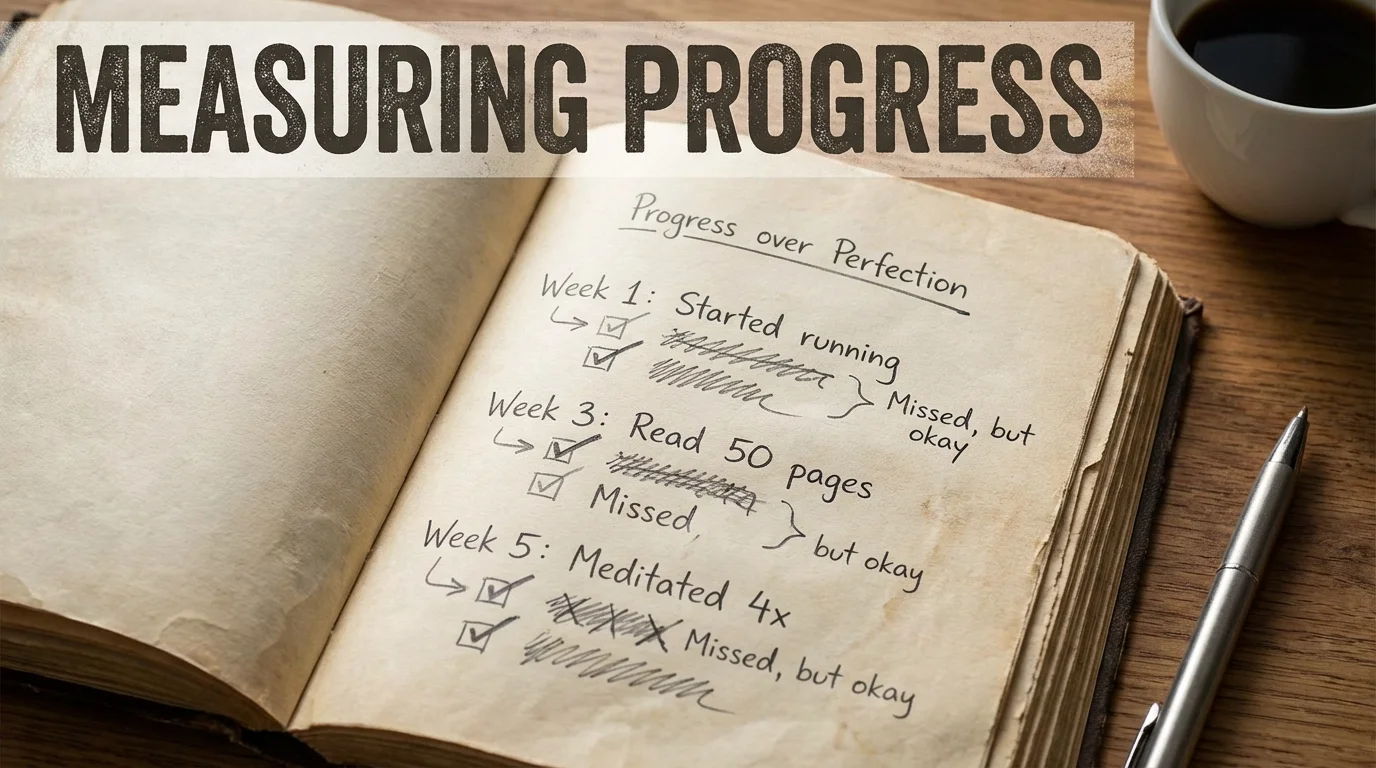
A journal showing a record of consistent daily habits.
Traditional metrics of success often focus on the quality of the output—how much weight was lost, how much money was earned, or how many pages were written. While these are important, they are often lagging indicators. For those of us striving for consistency, we must also track leading indicators, which are the behaviors that eventually lead to the desired results.
We recommend using a habit tracker that focuses solely on the act of completion. The goal is not to have a "perfect" score in terms of quality, but to have a "complete" score in terms of appearance. Seeing a visual representation of our consistency provides a powerful dopamine hit, reinforcing the behavior. We should celebrate the fact that we wrote for ten minutes on a day when we felt like doing nothing at all. This is a greater victory than writing for four hours on a day when we felt inspired.
Additionally, we should look for non-scale victories. Are we feeling more disciplined in other areas of our lives? Is our baseline level of energy higher? Is the "resistance" we feel before starting the task decreasing? These are the signs that the routine is becoming part of our neurological architecture. By valuing these qualitative shifts, we reduce our dependency on perfect outcomes and find satisfaction in the process itself.
Integrating Flexibility into Your Daily Schedule
Bamboo bending in the wind symbolizing routine flexibility.
True consistency requires an adaptive mindset. A rigid routine is a brittle routine. We must learn to distinguish between the "core" of our routine and the "ornamentation." The core consists of the non-negotiable actions that drive 80% of our results. The ornamentation consists of the extra details that are nice to have but not essential. When time is scarce, we should confidently strip away the ornamentation to protect the core.
We must also practice contextual awareness. A routine that works during a standard work week may not work during a holiday or a business trip. Instead of abandoning the routine, we should have a "travel version" or a "busy version" of our habits. This level of flexibility ensures that we never truly stop, even if the form of the habit changes.
Finally, we should regularly audit our routines to ensure they still serve our primary objectives. As we grow and our priorities shift, our routines must evolve. Consistency does not mean doing the exact same thing forever; it means consistently aligning our actions with our values. By allowing our routines to be fluid and responsive to our needs, we ensure they remain sustainable for the long haul.
In conclusion, we must reject the tyranny of perfection in favor of the power of consistency. It is the daily, mundane, "good enough" actions that build the foundations of greatness. By showing up, even when we are tired, even when the results are mediocre, and even when the world is chaotic, we are doing the hard work of transformation. Perfection is a destination we may never reach, but consistency is a path we can choose to walk every single day. Let us stop waiting for the perfect moment and start building the consistent life we deserve.