Simple Ways to Build Strength Without Overcomplicating Your Routine
In the modern era of fitness, we are often inundated with an overwhelming array of periodization models, complex supplement protocols, and high-tech wearable devices that promise to optimize every second of our training. However, the pursuit of physical strength does not require a degree in exercise science or a convoluted schedule that leaves us mentally exhausted before we even reach the gym. We believe that the most effective path to a more resilient and powerful physique lies in radical simplicity. By focusing on the foundational principles of human movement and the biological laws of adaptation, we can achieve extraordinary results without the unnecessary clutter of over-engineered programs.
Our objective is to strip away the noise and provide a comprehensive framework for building functional strength. This guide explores how to prioritize the movements that offer the highest return on investment, how to manage recovery effectively, and how to cultivate a mindset that favors consistency over novelty. When we simplify our approach, we remove the barriers to entry, making it far more likely that we will remain committed to our goals over the long term.
The Philosophical Foundation of Minimalist Strength Training
An athlete performing a barbell squat to demonstrate the power of simple compound movements.
The primary reason many individuals fail to see significant progress in their strength journey is not a lack of effort, but a lack of focus. We often see trainees jumping from one "revolutionary" program to another, never spending enough time on a single stimulus to force a true neuromuscular adaptation. This "program hopping" is the enemy of progress. To build genuine strength, we must embrace the concept of effective minimalism. This does not mean doing the bare minimum; rather, it means doing only what is necessary to trigger growth and nothing more.
When we look at the history of physical culture, the strongest individuals have always relied on a small handful of compound movements. These exercises involve multiple joints and muscle groups working in unison, allowing us to move the heaviest loads possible. By concentrating our energy on these high-leverage movements, we maximize our mechanical tension and metabolic stress, the two primary drivers of muscle hypertrophy and strength gains. We must view our training sessions as a series of high-quality repetitions rather than a quest for total exhaustion. Strength is a skill, and like any skill, it requires frequent, high-quality practice.
Mastering the Five Essential Movement Patterns
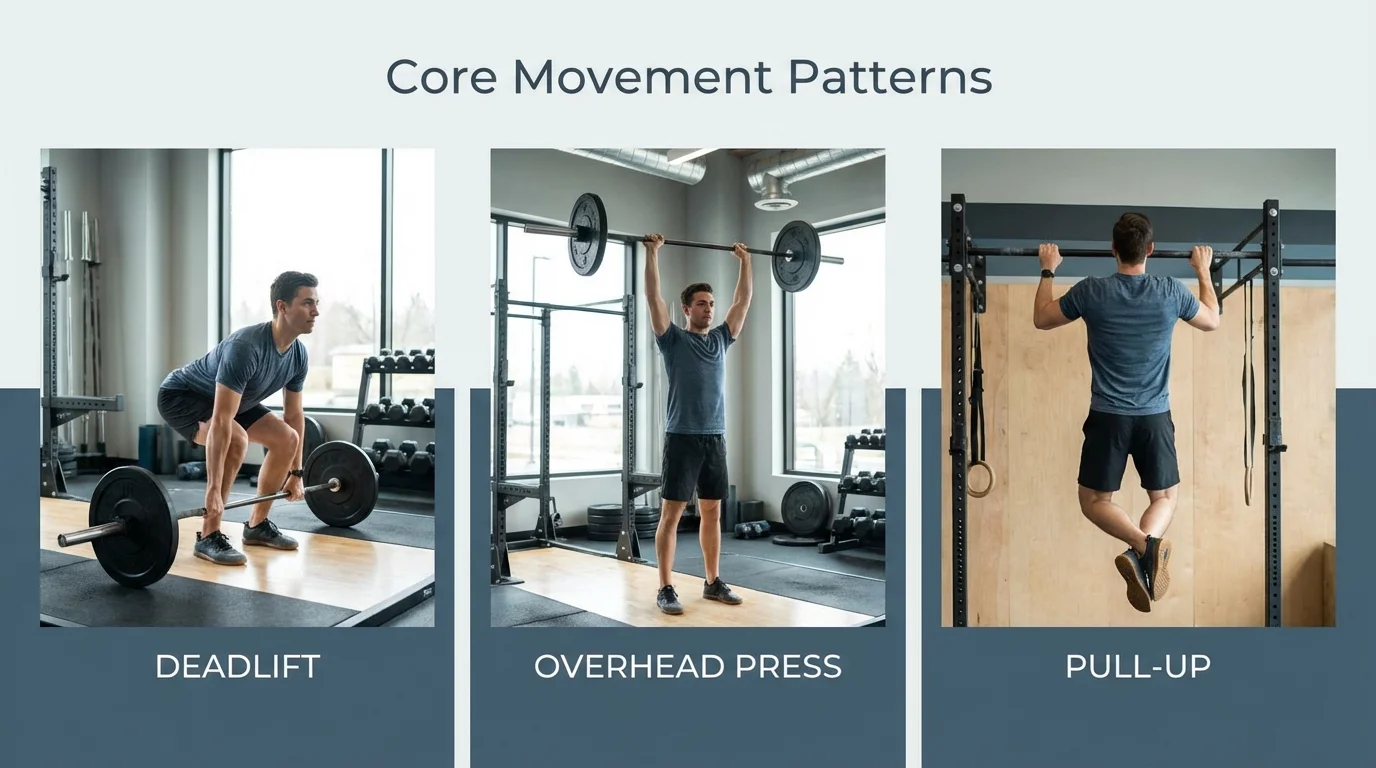
A composite image illustrating the fundamental movement patterns of strength training.
To keep our routine simple, we categorize human movement into five primary patterns: the squat, the hinge, the push, the pull, and the loaded carry. Every effective strength program should be built around these pillars. We do not need dozens of isolation exercises for the biceps or calves if we are consistently challenging ourselves with these foundational patterns.
The hinge pattern, exemplified by the deadlift, is perhaps the most critical for developing the posterior chain—the glutes, hamstrings, and lower back. This movement teaches us how to move heavy loads using our hips while maintaining a rigid, protected spine. Similarly, the squat
targets the quadriceps and core, building the "engine" of the lower body. For the upper body, we prioritize pressing (both vertical and horizontal) and pulling (such as rows and chin-ups). Finally, the loaded carry, like the farmer’s walk, builds "canalized" strength and grip power that carries over into every aspect of life. By rotating through variations of these five patterns, we ensure total-body development without the need for complex machinery.
The Irrefutable Law of Progressive Overload
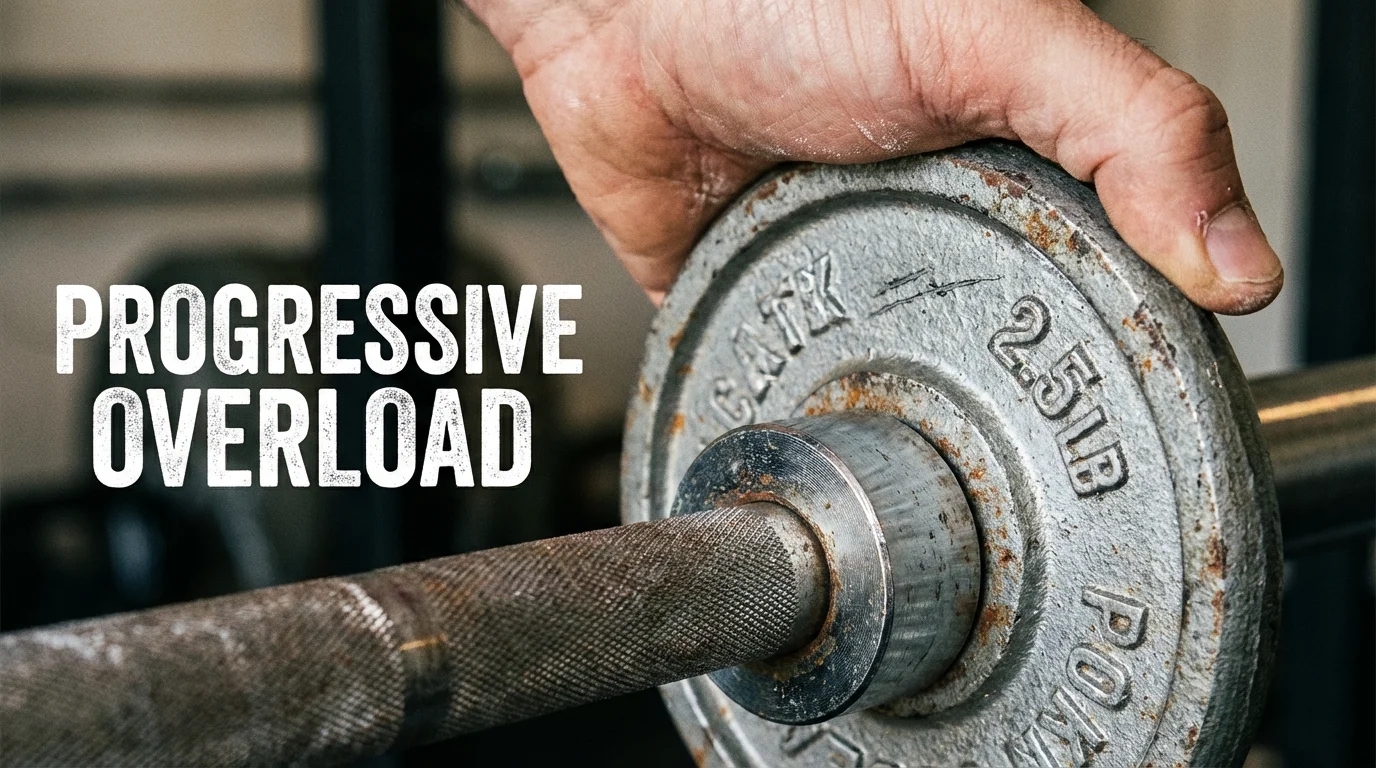
Close-up of a weight plate being added to a barbell to symbolize incremental progress.
If there is one "secret" to building strength, it is progressive overload. Our bodies are incredibly efficient at adapting to stress, but they will only change if they are forced to. If we lift the same weight for the same number of repetitions every week, we will stay exactly as strong as we are today. To get stronger, we must systematically increase the demands placed on our musculoskeletal system.
In a simplified routine, we track this progress through three primary levers: load, volume, and density. The most straightforward method is to increase the weight on the bar over time. Even adding a mere five pounds every two weeks results in a massive increase in strength over a year. We can also increase the number of repetitions performed with a specific weight or decrease the rest periods between sets to increase training density. We recommend keeping a simple training log to ensure that every session is a purposeful attempt to outperform our previous self. Without data, we are merely guessing; with data, we are engineering our own evolution.
Designing a Sustainable and Efficient Weekly Schedule
A minimalist planner showing a three-day strength training schedule.
A common mistake is believing that more time in the gym equates to more results. For the vast majority of people, high-frequency training leads to burnout and injury rather than peak performance. We advocate for a three-day full-body split or a four-day upper/lower split. These schedules provide the perfect balance between stimulating the muscles and allowing the central nervous system (CNS) to recover.
In a three-day routine, we might perform one variation of each of the five movement patterns in every session. For example, Monday could focus on heavy squats and overhead presses, Wednesday on deadlifts and weighted chin-ups, and Friday on front squats and bench presses. By hitting the entire body multiple times per week, we keep the protein synthesis levels elevated and provide frequent "practice" for the nervous system to learn how to recruit motor units more effectively. This approach is not only time-efficient—often requiring less than 60 minutes per session—but it also ensures that we are never too sore to function in our daily lives.
Streamlining Nutrition for Optimal Muscle Recovery
A high-protein, balanced meal showcasing simple nutrition for strength athletes.
Nutrition is often where people overcomplicate their lives the most, obsessing over "window of opportunity" timing or expensive supplements. We believe that strength-focused nutrition can be distilled into three simple rules: eat enough protein, maintain a slight caloric surplus or maintenance, and prioritize whole foods.
Protein is the building block of muscle tissue. We should aim for approximately one gram of protein per pound of body weight to ensure that our bodies have the necessary amino acids to repair the damage caused by heavy lifting. Carbohydrates provide the glycogen necessary for high-intensity efforts, while healthy fats support hormonal health, particularly testosterone levels, which are vital for strength. We do not need to count every single calorie if we focus on nutrient-dense foods like lean meats, eggs, tubers, and green vegetables. Supplements should be treated as the "cherry on top"—creatine monohydrate and a high-quality whey protein are usually the only tools necessary for the vast majority of trainees.
The Critical Importance of Recovery and Sleep
A peaceful bedroom setting emphasizing the role of sleep in physical recovery.
We do not get stronger in the gym; we get stronger while we sleep. Training is the stimulus, but recovery is the actual process of building new tissue and strengthening the nervous system. If we ignore our recovery, we are essentially digging a hole that we can never climb out of, eventually leading to overtraining syndrome and plateaus.
To optimize recovery without complex routines, we must prioritize seven to nine hours of high-quality sleep per night. During deep sleep, the body releases growth hormone and undergoes significant tissue repair. Additionally, we should incorporate active recovery on our off days—low-intensity activities like walking, swimming, or light yoga. These activities increase blood flow to the muscles without adding significant stress to the CNS. We must listen to our bodies; if our grip strength is failing or our motivation has vanished, it is often a sign that we need a deload week. A deload involves reducing the intensity and volume of our training for seven days to allow accumulated fatigue to dissipate, setting us up for a new cycle of growth.
Cultivating Consistency Through Habit Architecture
Silhouette of a person at sunrise, representing the consistency of a fitness routine.
The most sophisticated program in the world is worthless if it is not followed. The final and perhaps most important "simple" way to build strength is to master the art of consistency. We often overestimate what we can do in a month but underestimate what we can achieve in a year of steady, uninterrupted effort.
To build this consistency, we should focus on habit architecture. This means making the gym as frictionless as possible. We pack our bags the night before, we follow a pre-written plan so we never have to think about what to do next, and we focus on "showing up" even on days when we don't feel 100%. Strength is built in the aggregate. A "mediocre" workout performed consistently every week for a year will yield far better results than a "perfect" workout performed sporadically. By lowering the cognitive load of our routine, we make it an integrated part of our lifestyle rather than a chore that requires immense willpower.
Conclusion: The Path to Lasting Power
Building a strong, capable body does not require us to sacrifice our mental well-being or our time on the altar of complexity. By adhering to the fundamental movements, respecting the law of progressive overload, and prioritizing recovery, we can achieve a level of physical prowess that most people believe is reserved for professional athletes. We must remember that in the world of strength, the simplest solution is often the most profound. Let us cast aside the distractions, focus on the heavy iron, and trust in the process of gradual, relentless improvement. The journey to strength is a marathon, and by keeping our routine simple, we ensure that we have the endurance to reach the finish line.